
A Survivor Speaks: Mindu hornick
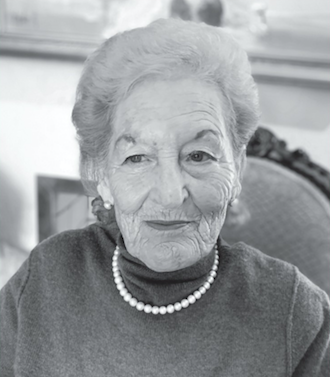
My name is Mindu Hornick. I am a survivor of the Ghetto, Auschwitz Concentration Camp, and a slave labour camp in Germany. I was born in eastern Czechoslovakia, now known as Slovakia, in May 1929, where my parents lived in a small village. I was one of four children: my sister was two years older than me, and I had two younger brothers. We had a very happy family life until 1939, when everything changed.
Hitler invaded Czechoslovakia, the country was divided, and the area where we lived was handed over to Hungary. Our school became Hungarian, and my father was drafted into a forced labour battalion. After one visit home, we never saw him again. In 1941, when I was 12 years old, most of the Jewish community in the Hungarian territory was rounded up, put into lorries, and taken away—except for families whose men had been taken into the so-called army. Our neighbours and school friends began to treat us differently due to the propaganda of the time. We felt isolated and frightened. We were forbidden to go to swimming pools, parks, and the cinema, and we had to wear the yellow star.
In 1944, when I was 14, our family, together with the few remaining Jewish families in our village, was taken by lorry to the Košice ghetto. A few weeks later, we were rounded up again and put into cattle trucks. After a three-day journey in suffocating conditions, without food, water, or sanitation, and with no knowledge of where we were going, we arrived at a place called Auschwitz in Poland—a place no one had ever heard of.
When the doors of the cattle truck were eventually opened, the sights and sounds were terrifying. A Jewish man in striped clothing came into the truck and asked my mother in Yiddish how old my sister and I were. He told us to say that we were 19 and 17, that we were seamstresses, and that we should go ahead of my mother and brothers, telling us that we would see them later. Reluctantly, we did—and we never saw them again. Some hours later, we learned that they had been sent straight to the gas chambers.
That man knew what was going to happen and saved my sister and me from the same fate as our mother and brothers, because we were old enough to possibly survive. But the reality of what we saw and experienced in those first hours and days was nightmarish and unimaginable.
Once in the camp, my sister and I were showered, deloused, and shaved of all our hair. We were given ill-fitting camp clothes and wooden clogs, but no underwear. That night, we saw that our sleeping quarters were extremely overcrowded, with nowhere to sleep, so we sat on the cold floor. Toilet facilities were beyond primitive. We survived on the most meagre and inadequate rations of food.
We were put to work in Kanada, where all the belongings and valuables brought by the Jews to the camp were sorted. Our days consisted of at least two roll calls involving selections for life or death, lasting up to two hours in all weather, as well as hard labour. Because we were together, and because an aunt and some cousins who were also there found us and took care of us as best they could, we managed to survive the horrors of that place for several months.
After that time, 500 girls and women, including us, were transferred to a slave labour camp—an underground munitions factory in woods in Germany—where conditions were slightly better. It was not a death camp, but the work was very hard and many of the guards were cruel.
After eight months, we realised the end of the war was approaching. We heard planes and bombing, and the guards became increasingly edgy. One day, we were ordered to board a train, once again unaware of our destination. The train was bombed by the Allies, who did not know we were slave labourers, and the train driver was killed. Some time later, another train arrived and we boarded it, only for yet another bombing to occur near the town of Plön. I saw many bodies and wounded people; over 50 were killed. My sister saw that I was still alive and dragged me out of the carriage to safety.
Our intended destination was Lübeck harbour, where we were to be put on one of three SS ships holding almost 9,000 slave labourers. These ships were to be blown up by the Germans to destroy the evidence before surrender. Unknown to us at the time, there was no more room for our group. The ships were later bombed by the RAF after liberation, mistakenly believing they carried German SS personnel.
Meanwhile, our group of sick and wounded girls was forced to march toward Lübeck harbour. When we reached Plön, we were so exhausted that we could not continue and collapsed on an embankment. A nearby train was waiting to take us to Lübeck, supposedly to the Red Cross, but we refused to board it. We were then told that the guards and officers were going into captivity and that we were free. That was our liberation.
By the age of 14, I had witnessed and endured unimaginable hardship, hunger, cruelty, and death. I survived being forced from our village to the Košice ghetto, Auschwitz concentration camp, and Neuengamme’s slave labour camp. I survived being fired upon twice on trains by the British, and above all, I had to face the reality of what had happened to my mother, my two little brothers, my grandparents, many aunts, uncles, cousins, and the unknown fate of my father. I survived through luck, through being with my sister, and through the care of our aunt and cousins. Many miracles.
I do not have time here to share what happened after the war. Suffice it to say, it was a long journey of recovery, reunification with surviving family members in Prague, returning to school, and eventually, when the Russians threatened Czechoslovakia, finding my way to England with the help of one of my mother’s brothers, who had joined the Czech British Legion and later lived in Birmingham.
Here I began a new life, which took considerable adjustment. I did not speak English, and life was very different from Prague. I found my place in the local Jewish community, married, and had two children. They, along with my two grandchildren and two great-grandchildren, are a source of great joy and an ongoing legacy that Hitler aimed to destroy.
This year’s theme is Bridging the Generations. When I came to England, no one wanted to hear about what had happened to us. People were focused on the impact of the war on their own families, and they couldn't conceive of what had happened in Europe. As a result, I did not speak about my experiences, except to one Bergen-Belsen survivor of my own age who became my lifelong friend. I never shared my story with my husband, who did not want me to relive my painful past.
After my husband died in 1974, my teenage daughters began to ask questions. By then, the Holocaust had become more openly discussed through books and films. It was difficult for them to grasp the enormity of my childhood, and it gradually became important to me that they should understand. I began speaking publicly about my experiences around 25 years ago, and since then, I have spoken to thousands of schoolchildren, university students, and adults, even though it remains a great ordeal each time.
For survivors, Bridging the Generations has many meanings. For me, it is about sharing what happened to me and to the generations of my family who perished. I hope that those who hear my story will remember it and that sharing my experiences will help ensure that such a catastrophe never happens again. It invites us to honour every life lost and to recognise the resilience of survivors who rebuilt their lives and created new generations. As Jewish survivors become fewer, their children and grandchildren will carry their stories forward, supported by testimony, film, and books.
Thank you for inviting me to speak today. My wish for the future is that Holocaust Memorial Day events continue to remember the meticulously planned destruction of the Jewish people, as well as the more recent genocides of others. I hope this commitment encourages all who attend to ensure that every human being has the right to live with dignity and justice, regardless of faith, race, colour, sexuality, or disability.
Thank you.