
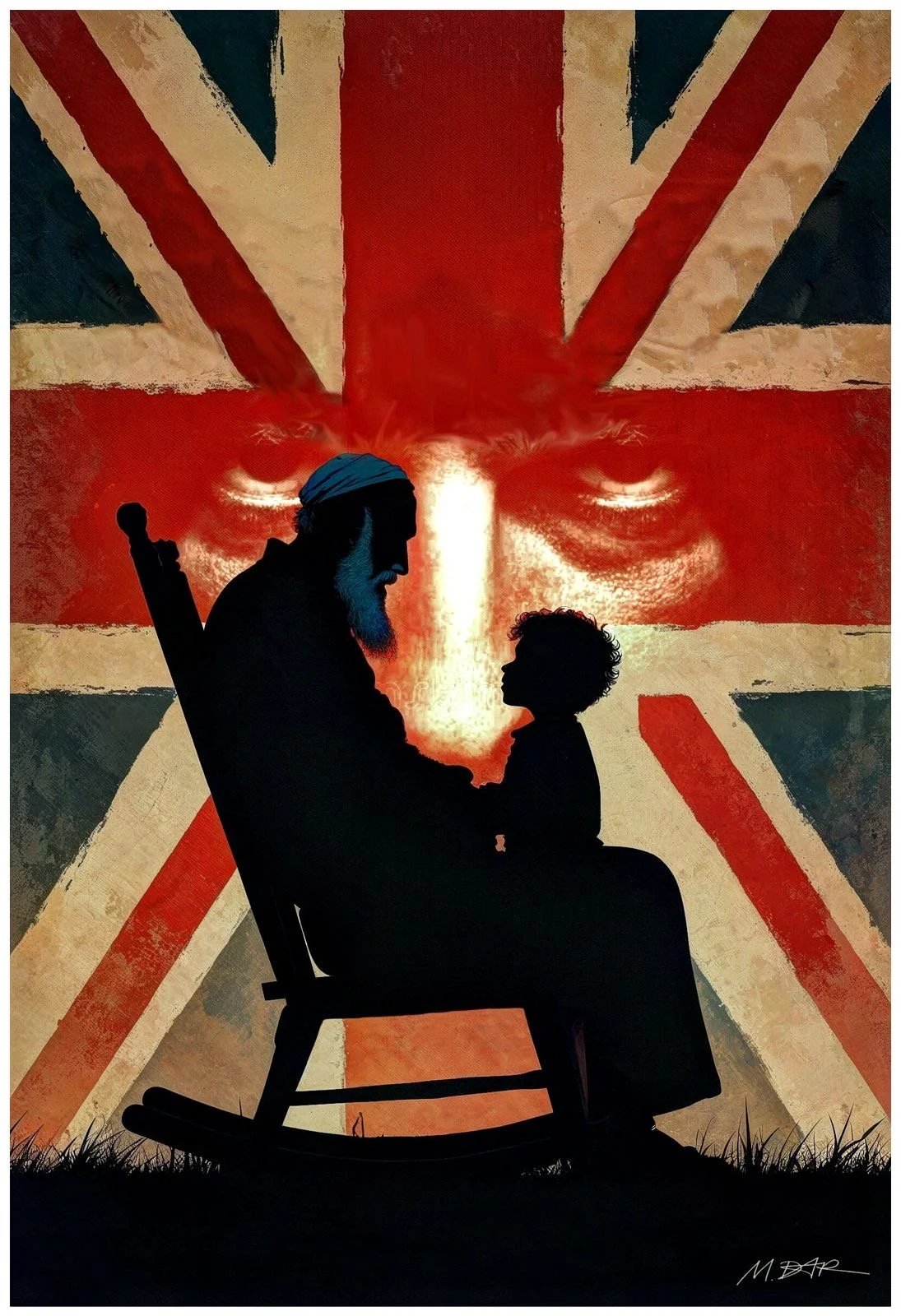
One autumn afternoon in Sheffield, my father, a former steelworker whose hands had helped build the furnaces of South Yorkshire, sat in palliative care holding his two-year-old great-grandson. Four generations of the Dar family in one room, the family shaped by Britain — through migration, labour, settlement and survival. Yet even in that quiet room, the television flickered images from the racist riots that erupted after the Southport killings on 29 July 2024. A hotel housing refugees in Rotherham burned while men wrapped in flags celebrated the spectacle. Mosques were attacked. Streets became sites of organised terror. My father watched silently before turning to me with the weariness of someone who understood history as a lived experience. “One day they’ll try to kick you out,” he said quietly. “It doesn’t matter how long we’ve been here. Our passport is the colour of our face, and our religion marks us out as a target.”
He is buried now in Sheffield soil beside fellow migrant steelworkers who arrived from Pakistan to rebuild Britain after the war. Their labour enriched Britain; their children defended themselves against racism; their grandchildren are once again being told they do not belong.
As a founding member of the Sheffield Asian Youth Movement in the 70’s and 80’s, I remember another Britain convulsed by economic collapse. Entire industries were dismantled. Communities were hollowed out as factories closed, wealth concentrated elsewhere and working people were left to absorb the consequences. But instead of directing anger towards those responsible for unemployment, poverty and social decay, political elites and sections of the media redirected that anger towards migrants and Black communities.
Racism became a mechanism for managing social crises, something which feels familiar today. The “Paki-bashing” of that era was not random prejudice. It was political violence born from conditions of despair and abandonment. Asian and African Caribbean communities became convenient scapegoats for a country increasingly divided between immense wealth and deepening hardship. The police criminalised us when we defended ourselves, while fascists marched openly through working-class areas.
In response, Asian Youth Movements emerged across Britain. We organised not as cultural associations, but as anti-racist, anti-imperialist formations rooted in solidarity and collective self-defence. Muslims, Sikhs, Hindus, Christians and non-believers stood together because racism did not distinguish between us. We understood something essential: division protects those in power; unity threatens them.
That lesson matters profoundly today.
The rise of Tommy Robinson and the contemporary far right cannot be understood outside the wider breakdown of social life that has unfolded over decades. Communities stripped of industry, public services pushed to collapse, insecure work, rising poverty and a growing sense that political institutions no longer serve ordinary people have created fertile ground for resentment and despair. Yet instead of confronting the structures that produce inequality, mainstream politics has increasingly legitimised narratives that racialise migrants, refugees and Muslims as threats, burdens or outsiders.
The far right did not create this climate alone. The political centre prepared the ground for it.
The Southport riots demonstrated how quickly fascistic violence can emerge once racist mythology is legitimised. False claims that the attacker was a Muslim asylum seeker spread rapidly online. These violent repercussions did not emerge from nowhere. It was cultivated through years of anti-Muslim racism, anti-migrant scapegoating and nationalist rhetoric emanating not just from fringe organisations, but from mainstream parties and media institutions seeking to channel public anger away from entrenched inequality and towards the vulnerable. It is in this context that Tommy Robinson’s “Unite the Kingdom” mobilisation last weekend must be understood. The march set out to build upon the previous “Unite the Kingdom” demonstration held in London on 13 September 2025— a mobilisation widely described as the largest far-right street mobilisation in modern British history, drawing tens of thousands onto the streets under slogans of exclusion and “remigration”. It represents a dangerous convergence between organised fascists, anti-Muslim racist networks, nationalist populists and sections of a disillusioned middle class radicalised by social decline. History teaches us where this road leads.
We saw it in 1936 in London’s East End, Cable Street, when ordinary people blocked Oswald Mosley’s fascists from marching through London’s East End. That same spirit is urgently required now.
We should also recognise internal community tensions, where figures such as Tommy Robinson are often seen as contributing to narratives that can deepen divisions between communities, particularly within South Asian groups. This is why networks such as the South Asian Bridgers Network are important in helping to address these growing divides between Hindu, Sikh, and Muslim communities, reminding us of the importance of solidarity. We need those embedded within communities to unite, have uncomfortable conversations, and be able to stand together once again.
Fascism thrives when people feel isolated, fearful and powerless. It is defeated when ordinary people rediscover collective strength.
And so I return in my mind to that quiet Sheffield room: my father’s frail hands resting on the back of his great-grandson, four generations of one family shaped by migration, labour and struggle suspended in a single moment between memory and future. He may be gone now, but his words remain — not simply as a warning, but as a diagnosis. He understood that racism is repeatedly summoned in moments of social fracture, whenever those who wield power need others to carry the blame for a broken world.
The real question, then, is not whether we belong. After generations of labour, sacrifice and struggle, that question has already been answered by history itself.
The real question is whether Britain will finally learn that a society which endlessly manufactures outsiders eventually loses sight of its own humanity.
Mukhtar Dar is a cultural activist, artist, festival organiser and archivist. He was a founding member of the Sheffield Asian Youth Movement and later became active in anti-racist and community campaigns across Birmingham and the UK. He is the artistic director of Kalaboration Arts and founder of Unite the People Festival and Kings Heath United Against Racism.