
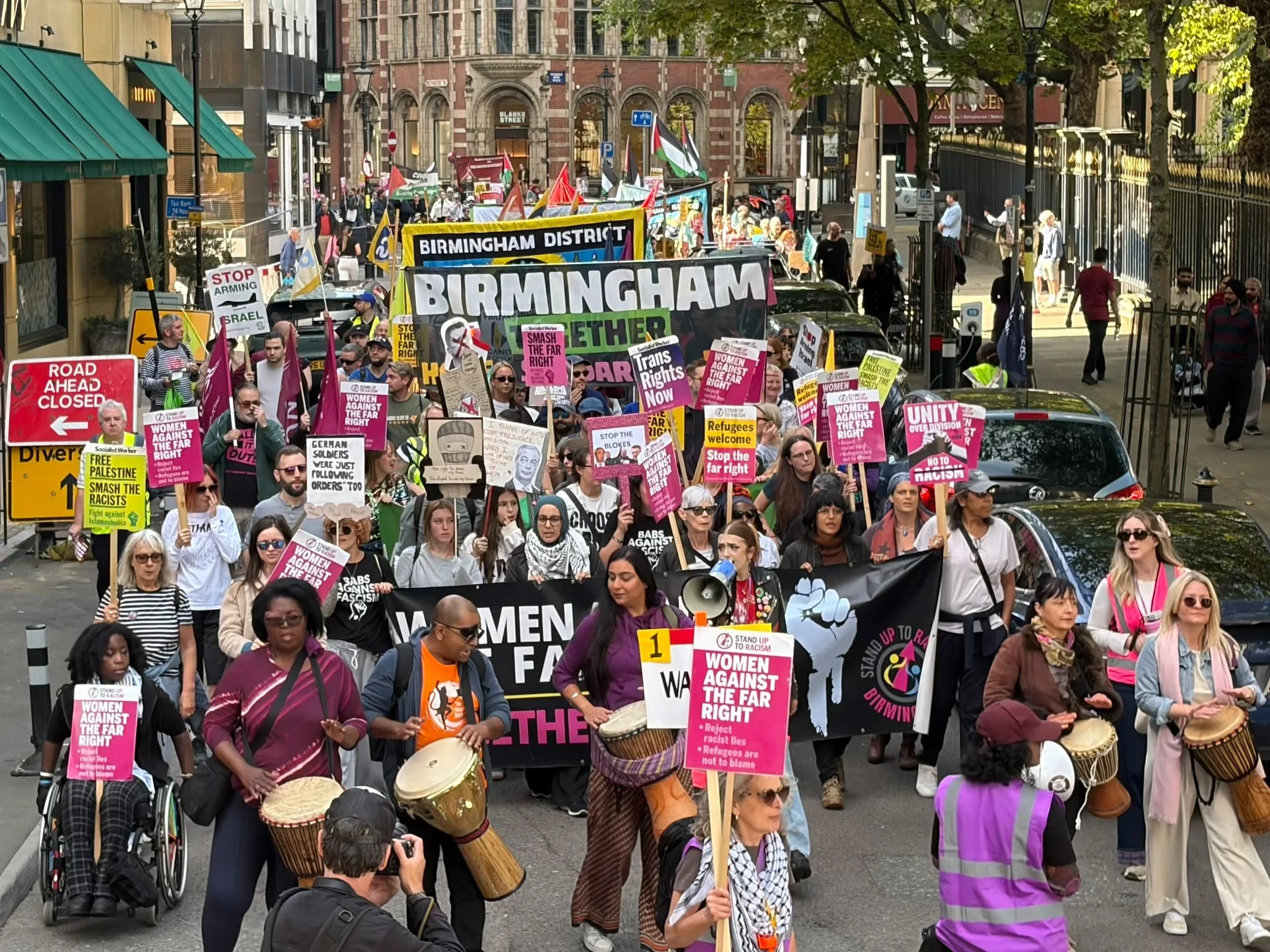
If ever you wanted a sign that community solidarity and courage will win, that it has always won, then consider the Battle of Cable Street in 1936 and the West Midlands Unity March of 4 October 2026.
There are 90 years between these events, and the fight continues.
On 4 October 1936, the people of East London courageously stopped the march of Oswald Mosley’s Blackshirts – this moment in history is recognised as the Battle of Cable Street.
A defining moment frequently referenced in anti-racist and anti-fascist movements as a true reflection of what happens when a local community draws itself together across perceived ‘differences’ in identity and acts strategically and in solidarity.
90 years on, the fight against fascism continues.
On 4 October 2026, SUTR Birmingham and TUC Birmingham called the West Midlands Unity March and Rally to draw together the many activists, organisations and residents across the West Midlands who believe in liberation, community and the need for solidarity in the face of growing fascism and racism in the UK and globally.
The event recognised the need to draw communities together to build relationships, share support for each other and have the experience in our bodies of what it means to stand together in solidarity.
Any event like this has standout moments: the sight of thousands of people marching down Corporation Street in Birmingham, the homemade signs and banners demanding trans rights, liberation for Palestine and an anti-racist solidarity movement, the sound of voices raised in unison calling out ‘Our streets!”
Each of these moments is captured in my mind and still brings goosebumps to my skin today, though we are over a month post-event.
But there is one moment, one choice, one feeling that stays with me more than any other from that day. It was the echo of Cable Street in our very own city.
As with any large-scale liberation event, the inevitable consequence is that those who are determined to tear our communities apart and sow hate decide to attend. They make it their business to disrupt, intimidate and use a place of celebration as a site of violence. The Unity March and Rally was no exception, and a small group of fascists turned up, insulted people, caused distress and upset.
As the community blocs were readying to leave Victoria Square to begin the march, a dedicated group of antifascist activists who had attended the event in commemoration of the Battle of Cable Street made the decision to stay behind, to sacrifice the opportunity to join the celebration and formed a line of counter-defence. This meant the far right agitators were blocked from following the march through the city centre. The antifascist bloc of activists stayed on the square determinedly.
As the community blocs re-entered the square, it was to the sight of a line of defence, of protection and a deep spirit of community solidarity. We returned with the reverberating chant ‘When human rights are under attack, what do we do? Stand up! Fight Back!’
We heard from across the square the steady chants of the antifascist activists ‘Siamo tutti antifascisti!’, a chant globally recognised for its message ‘We are all anti-fascist!’
As the march of thousands of bodies in synchronised voices filled Victoria Square in Birmingham City Centre, we steadily made our way over to support the antifascist activists who had sacrificed a moment of joy to truly live out the politics of solidarity. Thousands of voices raised in unison: ‘There are many, many, more of us than you.’ We chanted many times and stood at the backs of our antifascist community - those who choose to put themselves at risk for the safety of their wider community.
Suffice to say, the far-right agitators could eventually not even be heard in response to the calls from our communities, from across the West Midlands, joined in solidarity. It is no surprise that shortly after this, they left and the square was full of people enjoying the music and the rousing speeches of the rally.
This is my standout moment, watching a line of dedicated activists, joined in solidarity by thousands more. The raised voices of a community who refuse to be intimidated into submission. The hope and potential for our movement when we truly stand shoulder to shoulder.
Let me end with words much bigger and long-lasting than my own. Audre Lorde self-described as a Black, lesbian, feminist, socialist, mother, warrior, poet:
‘Without community, there is no liberation.’
Lakshnie Hettihewa is a local activist and works for brap.