
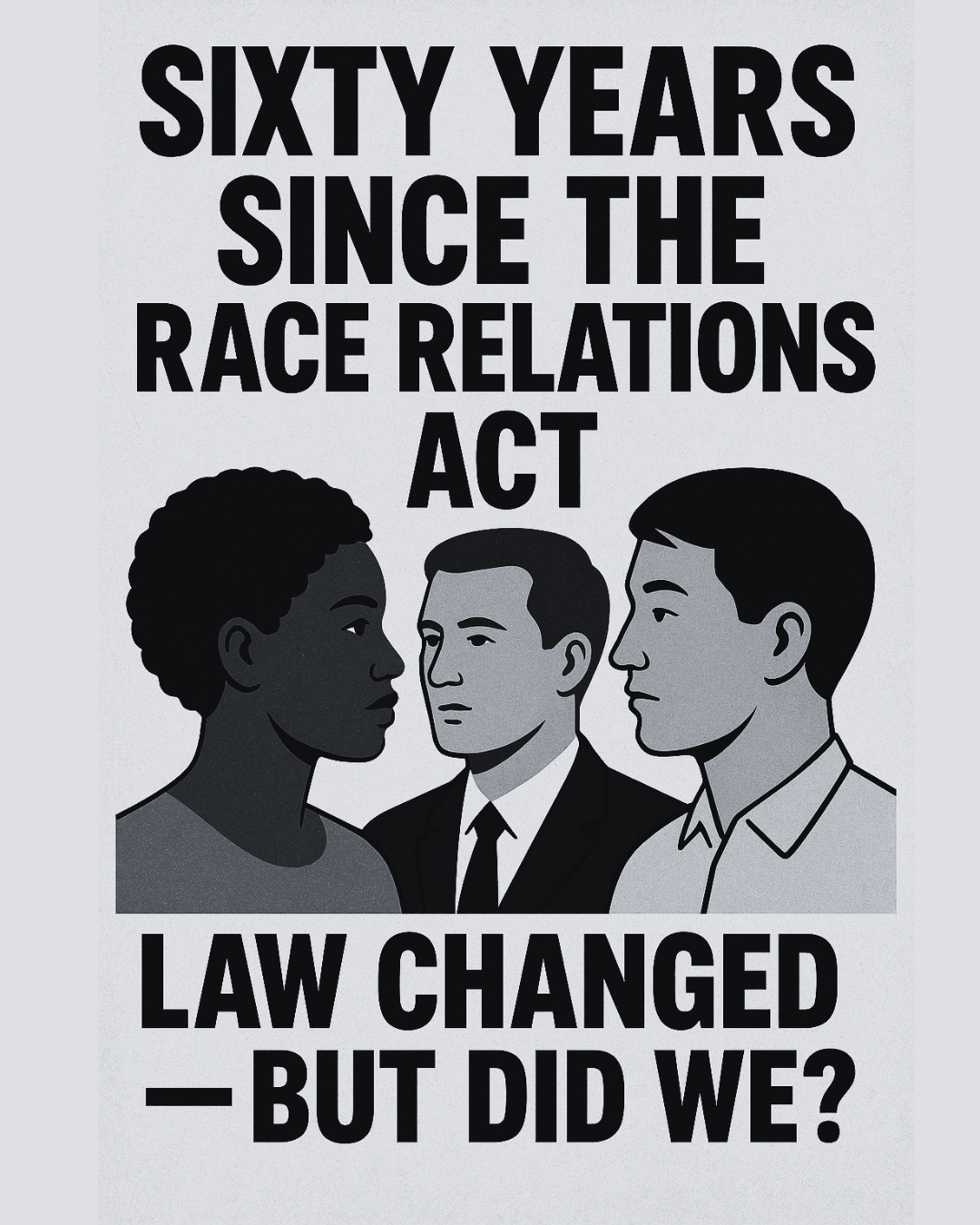
This month marks sixty years since the passage of the Race Relations Act 1965, a landmark moment in Britain’s legislative history. It was the first time the state formally outlawed racial discrimination in public spaces — a significant, symbolic step towards racial equality.
The Promise — and Its Limits
The 1965 Act banned discrimination on the grounds of race, colour, or ethnic or national origins in public places such as restaurants, theatres, and public transport. It also created the Race Relations Board, which allowed people to make complaints about discriminatory treatment.
However, the Act did not address discrimination in the areas where it was most pervasive — housing, employment, and public services — and its enforcement powers were limited. Many early critics argued that while the Act was an important symbol, it did little to change everyday experiences of racism.
Later amendments in 1968 and 1976 expanded protections and strengthened enforcement, laying important groundwork for today’s Equality Act. But the 1965 Act remains a historical turning point: the moment the state formally acknowledged that racial discrimination was not just immoral, but unlawful.
Still, a Law Doesn’t Change Hearts
As recent reflections from the Black Equity Organisation and Runnymede Trust stress, the lived experience of many Black and minoritised communities continues to reveal ongoing disparities. Despite decades of legislation, racial inequalities persist across employment, education, policing, housing, and health.
These organisations point out that while the law can prohibit discriminatory behaviour, it cannot alone dismantle the underlying cultural attitudes, implicit biases, and systemic barriers that create and sustain racial inequality.
The anniversary, therefore, is not just about celebrating progress — it is about recognising how far we still must go.
From Token Equality to True Equity
Marking sixty years since the first Race Relations Act invites us to reflect on the difference between equality and equity. The former promises equal treatment; the latter recognises that people start from different positions and may need different forms of support to achieve fairness.
Today’s challenge lies in confronting the subtle but deeply embedded systems that disadvantage Black and minoritised groups. This requires more than legislative reform — it calls for institutional accountability, meaningful representation, and cultural change.
What BRIG and Our Communities Can Do
For organisations like us at BRIG, this anniversary is a call to action. Some steps we can commit to include:
Creating space for honest conversations about race, identity, and the continuing realities of discrimination.
Demanding transparency and accountability from institutions whose decisions affect employment, policing, education, and local services.
Centred leadership from Black and minoritised communities, ensuring lived experience guides decision-making.
Moving beyond symbolic gestures, towards practical, sustained efforts to dismantle structural inequality.
Building momentum through education, advocacy, and community partnerships, ensuring these conversations lead to real change.
A Final Thought
Sixty years on, the Race Relations Act stands as a powerful reminder of how far Britain has come — and how far it still needs to go. Passing a law is one thing; transforming a society is another.
To truly honour the legacy of the Act, we must continue pushing for justice, equity, and dignity for all — not just in principle, but in practice.
Further Reading
• Black Equity Organisation – “Race Relations Act: 60 Years On”
• Runnymede Trust – “Sixty Years On From the Race Relations Act”
