
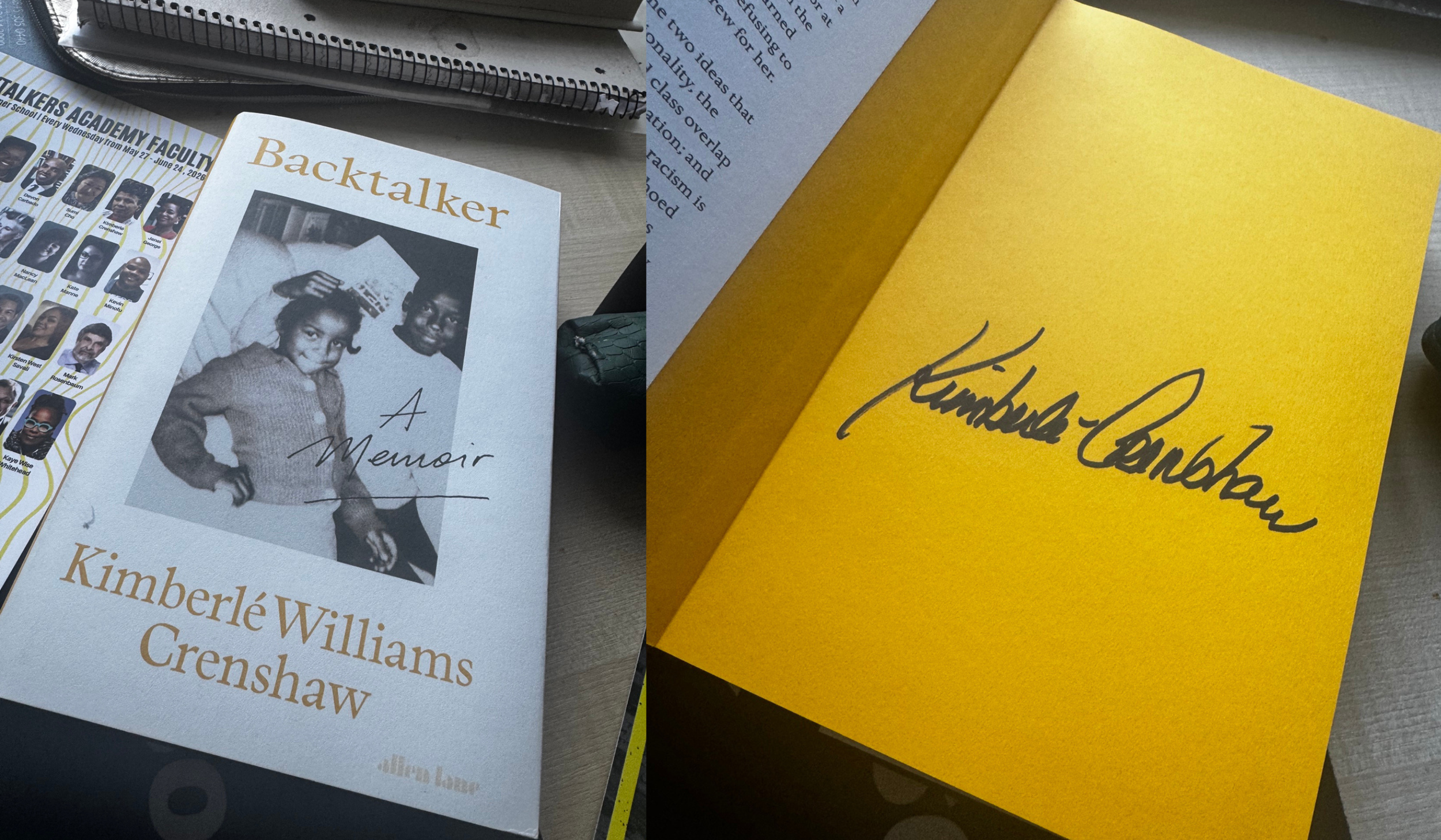
Signed copy of ‘Backtalker’ by Kimberlé Williams Crenshaw
Meeting Kimberlé Crenshaw when she came to talk about her new book in Birmingham felt like an historic moment; a moment perhaps akin to meeting someone like Malcolm X or Martin Luther King in their prime. You couldn’t help but feel the gravity of her presence in these times we are living in. This is a woman with a red target on her back as one of the central figures of a global culture war with the President of the USA, Donald Trump, taking direct aim. Crenshaw is responsible for naming two of the right-wing’s most hated ideas: intersectionality – a term that she coined to explain the experiences of women of colour subject to both race and sex discrimination and critical race theory – a field of academic scholarship that centres race and racism.
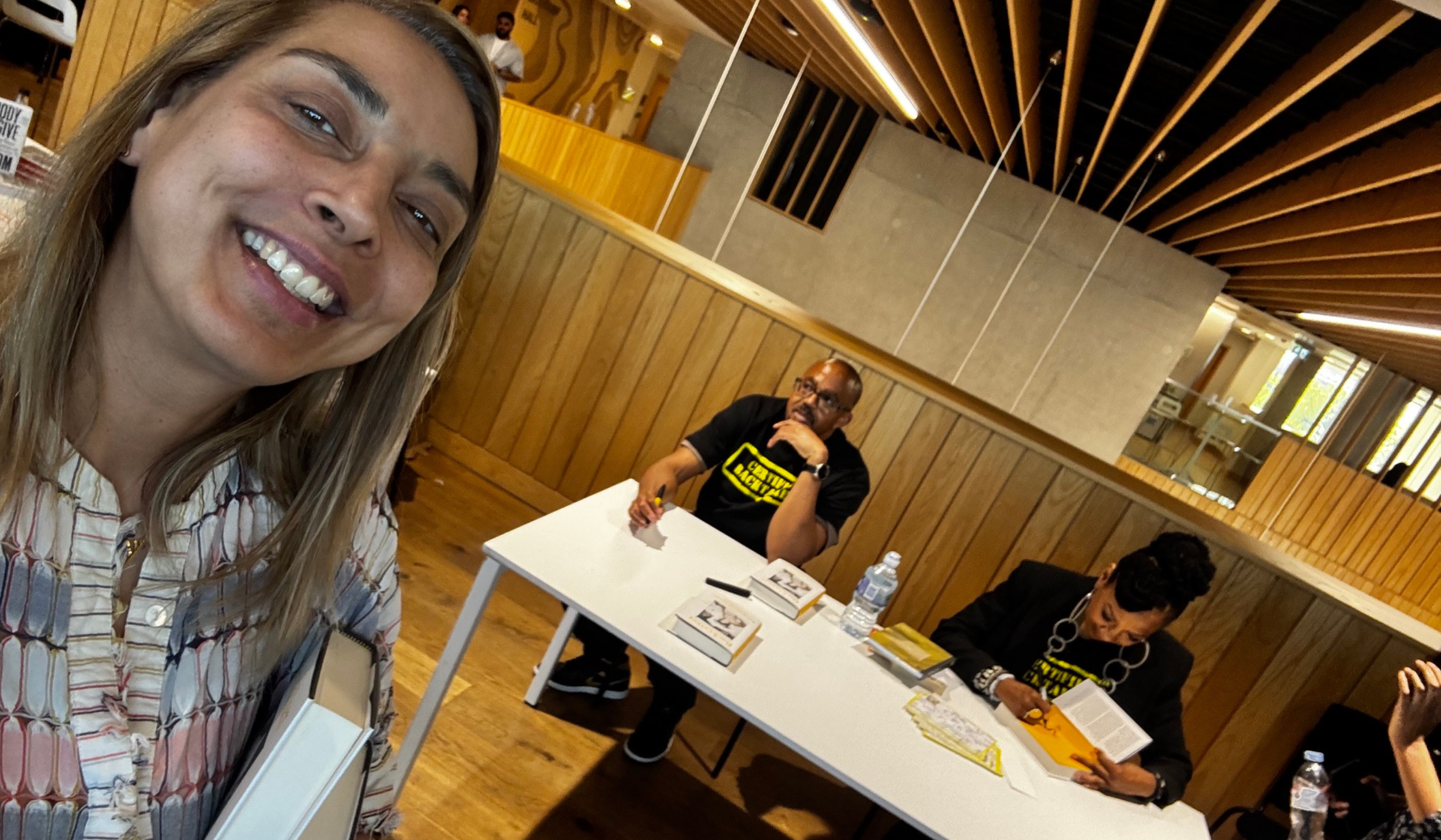
Nina Robinson is taking a selfie whilst her copy of Backtalker is signed by its author, Kimberlé Williams Crenshaw, who sits next to organiser and former Black Studies Professor Kehinde Andrews
She was invited to Birmingham City University’s Conservatoire Hall by their former Black Studies Professor, Kehinde Andrews, whose undergraduate and postgraduate courses were recently axed and whose post was made redundant. Such is the pressure on this area of academic thought that another Black professor, Jason Arday, was subject to an unprecedented and intense media frenzy, which ultimately claimed his life.
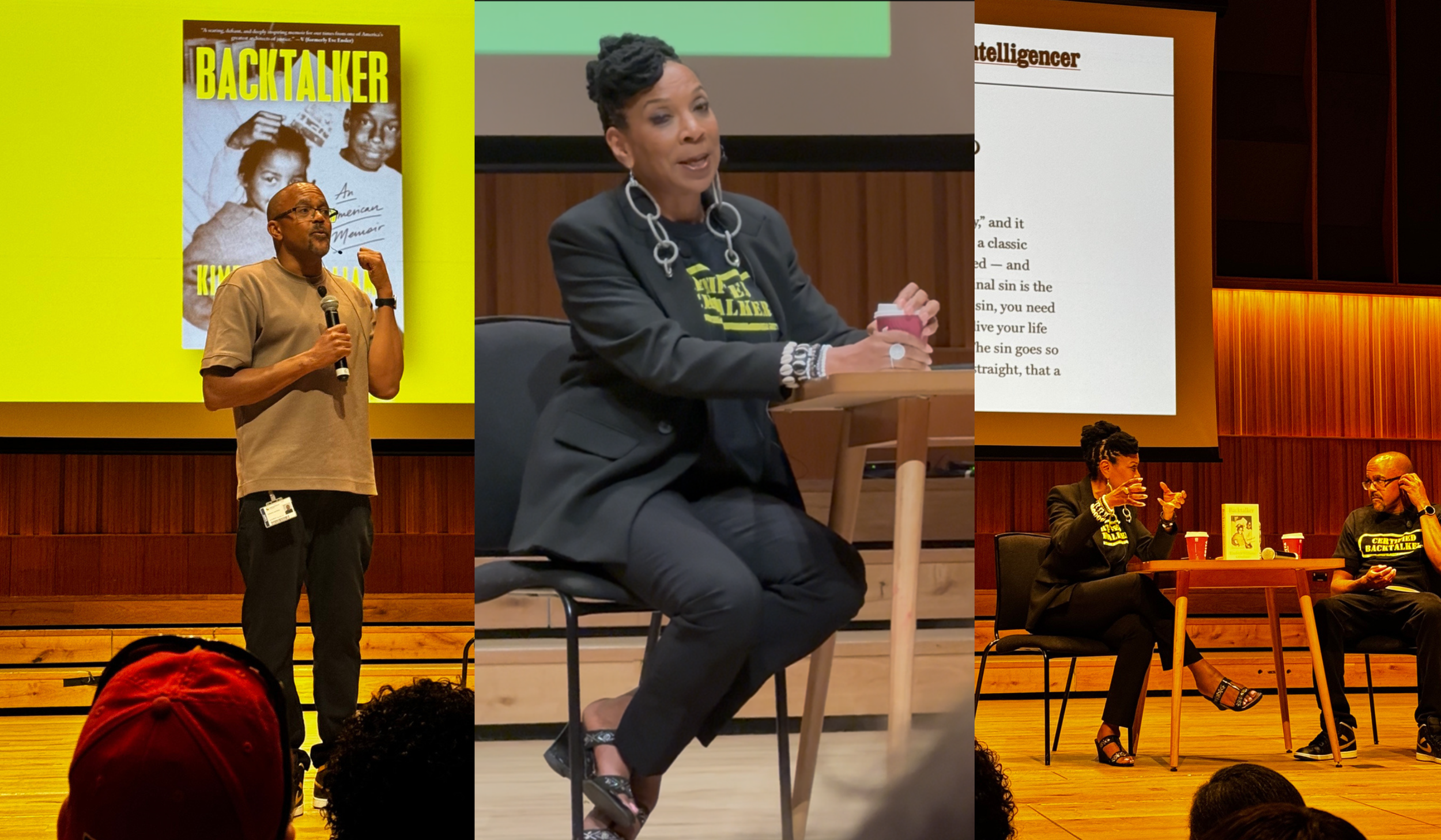
Central Image: Author Kimberlé Williams Crenshaw in Birmingham speaking at BCU Conservatoire
Amid this socio-political climate, Kimberlé Williams Crenshaw publishes her absorbing new book ‘Backtalker’, a memoir of her life which describes the moments which shaped her. It is an insightful look back, injected with reflective commentary. On her childhood, she details the thoughtful guidance she received from her middle-class family, who supported her brilliant and curious mind by acknowledging her experiences as a Black girl growing up in systems designed to ignore her. Her mother, who was a teacher, gave her recognition and opportunity to address the wrongs she was subjected to. She grieved terrible losses, and we glimpse her inner strength. She recounts experiences like the cancellation of a school theatre production, ‘Young Gifted and Black,’ which was deemed too controversial to stage. A young Crenshaw would have played the lead, but was instead offered a reduced role as a maid in ‘My Fair Lady’;
“From the entire drama came my clearest vision of the ways that racial power, masked as colour-blindness, operates to protect white comfort [and] non-whites are expected to foot the psychic bill. …it establishes the normalised centre of things to which we Black students would simply have to adjust.”
At Cornell and later Harvard Law School, Kimberlé Crenshaw continued her awakening, surviving an abusive relationship where the community she thought she could rely on let her down. This is where she develops her thinking on intersectionality;
“The sexual harassment of Black women would occasionally be mentioned …however, it is not exclusively an interracial problem. Black women are harassed by Black men as well as others.”
In her conversation with Kehinde Andrews at BCU, Kimberlé Crenshaw spoke about the opposition she had faced for calling out sexism by Black men, and the potential ammunition this gave to racists and a society which was trying to bring Black men down. Her answer was to talk about the collective ‘we’ as a thing which is not static; she stated that ‘we’ was a verb, something that people do. She argued that a Black woman telling her truth was not treason against the ‘we’, but rather it was the Black male abuser who was the treason-er against hard-won Black civil rights.
“Intersectionality became my own pair of X-Ray glasses that helped me see and explain the instances where Black women were subject to conditions that were both the same and different from Black men and white women.”
Intersectionality as a concept was developed further to explain experiences which cut across other lines, such as class and gender or gender and sexuality, for example and is now widely used; for example, you might say: As a working-class woman of colour with a Brummie accent, my intersectional experiences are shaped by my accent, race, class and gender.
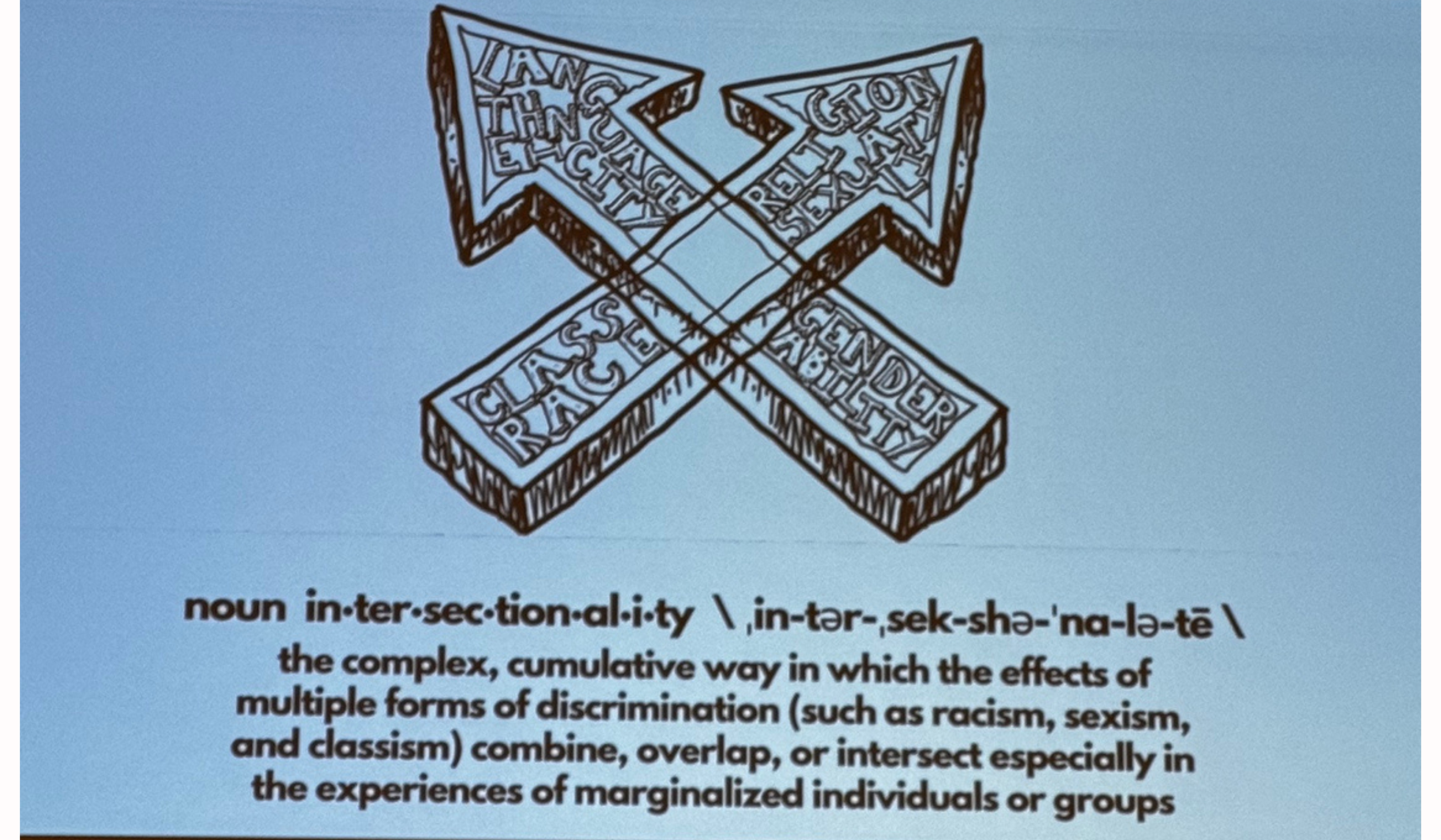
Photo of a Slide shown at Author Kimberlé Williams Crenshaw’s Birmingham event, illustrating intersectionality as arrows that cross.
In real life, Kimberlé Crenshaw radiates a collaborative spirit; she rallies people together – for example, when she was a student, she campaigned for the university to reinstate a course which had been run by Harvard’s first Black professor, Derrick Bell (who cited his colleagues’ reluctance to widen the pool of candidates of colour as a reason for leaving). Crenshaw campaigned for Harvard to hire Black faculty members and later, when she first came under sustained attack, she wrote to all those whom she knew would become subsequent targets, asking for their support.
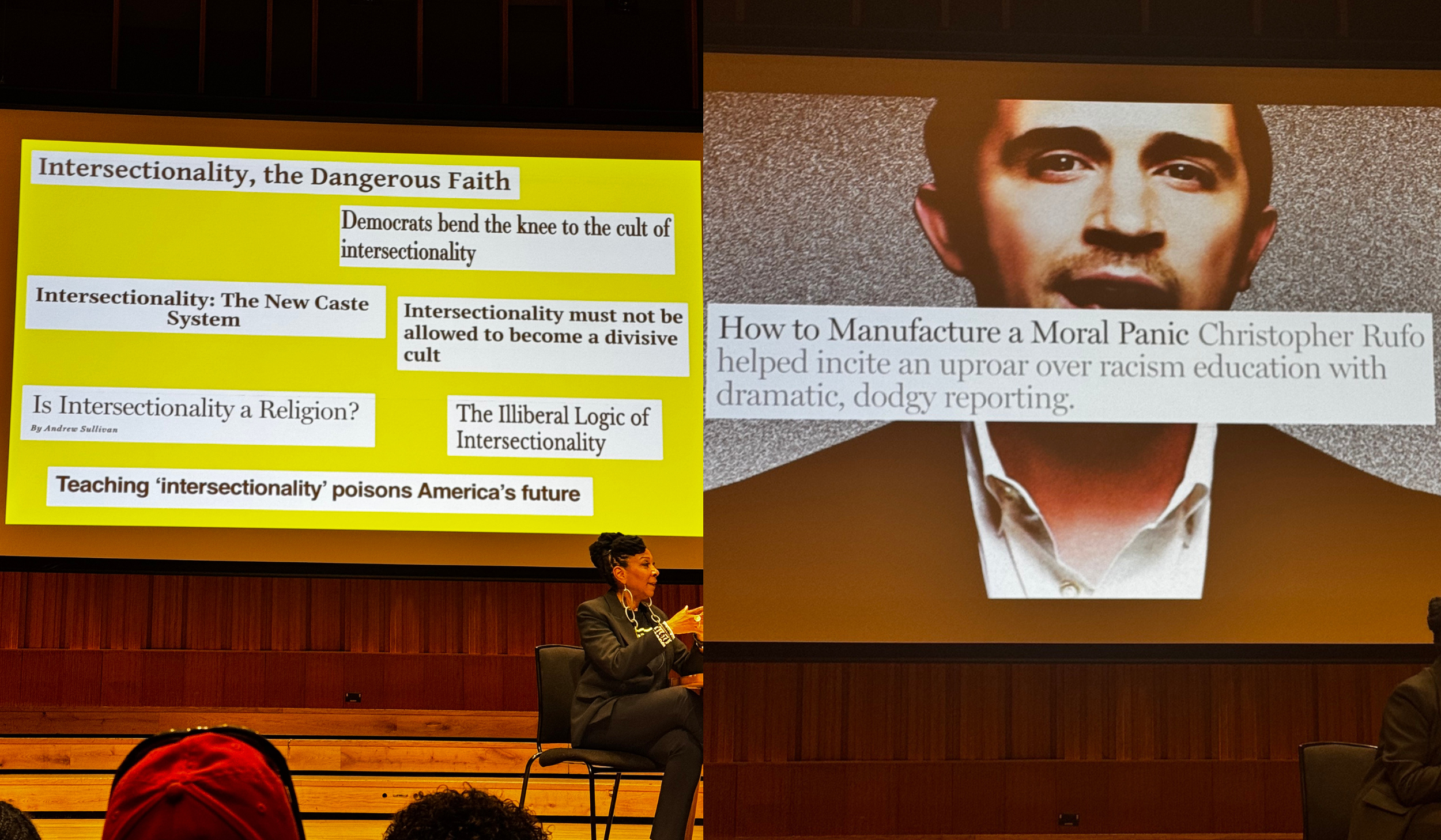
Author Kimberlé Crenshaw, in Birmingham, explains that the media attacks her, her writing, and her ideas have been subject to.
From her book you get an understanding of the underlying motives for her work which come from a positive place. Courage and a driving sense of justice through law, values once held dear in the USA. The humanity and vulnerability in her character are also exposed in this book. It’s an easy read into her ideas with some great suggestions for further reading, the final words must be hers from ‘Backtalker’;
“We devoured ‘This Bridge Called My Back’ a collection edited by women of colour… and of course we devoured bell hooks classic, ‘Ain’t I A Woman’ which gave a critique of color-blind racism and male-centric anti-racism ..and for me the book ‘All Women are White and All the Blacks Are Men, But Some of Us Are Brave’ fully expressed the conditions I was encountering”.
Full disclosure: The writer of this article signed the petition to prevent the closure of BCU Black Studies
Check out Birmingham Black-owned online bookshop
Buy Kimberlé Crenshaw’s book here and listen to her podcast Intersectionality Matters.
All photos taken by Nina Robinson.