
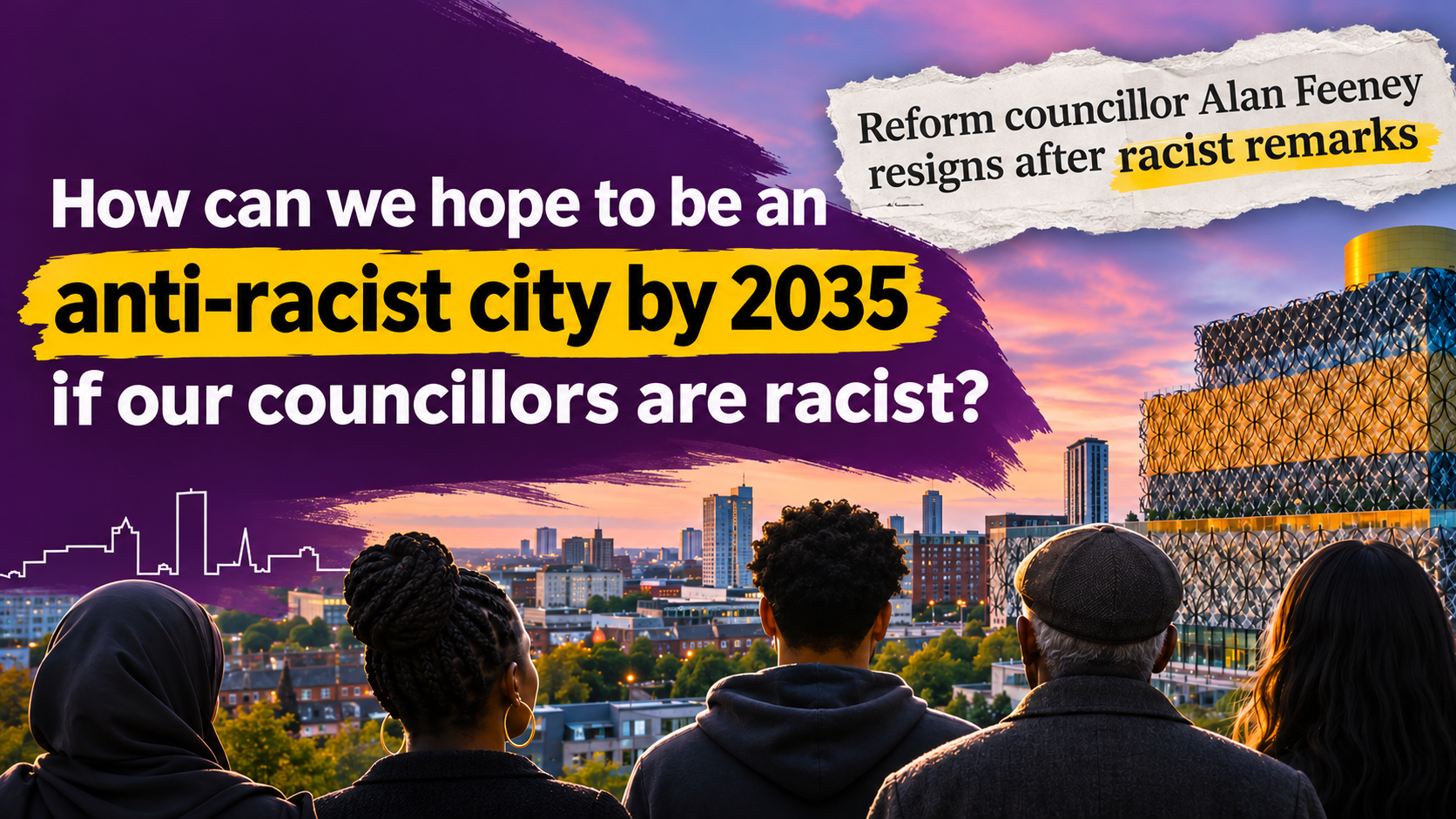
The resignation of former Reform UK councillor Alan Feeney following the exposure of racist remarks raises serious questions about racism, political accountability and Birmingham's ambition to become an anti-racist city by 2035.
Birmingham is one of the UK's most culturally diverse cities, home to communities from different ethnicities, religions and backgrounds. This diversity is central to the city's identity. Yet recent revelations involving former Birmingham City Councillor Alan Feeney have raised a troubling question: how can Birmingham hope to become a genuinely anti-racist city by 2035 when racism is being exposed among those elected to represent its communities?
In October 2026, an undercover ITV News investigation revealed footage of Alan Feeney, a former Reform UK councillor representing Shard End on Birmingham City Council and Castle Bromwich on Solihull Council, making deeply offensive remarks about Asian communities.
Feeney was recorded describing Asian homeowners as "parasites" and suggesting that no more than 1% of Britain's population should be non-white. His comments also included hostility towards Muslim communities and their place in British society.
Following the investigation, Feeney resigned from both councils and apologised, acknowledging that his remarks were offensive and unacceptable. Two other councillors featured in the investigation, Jamie Campbell and Chris Whelan, also resigned.
While these resignations represent an important act of accountability, they also raise wider concerns about the attitudes and prejudices that can exist within positions of public responsibility.
Beyond Resignation: The Need for Accountability
Elected councillors have a responsibility to represent everyone in their communities, regardless of race, ethnicity, religion or background. Their role is to serve the public fairly, listen to residents and ensure that decisions reflect the needs of the communities they represent.
When an elected representative expresses racist views, it risks damaging public confidence, particularly among communities that already experience discrimination and inequality.
The question is not simply whether an individual councillor should resign following racist remarks. It is also about how such attitudes can go unchallenged, what safeguards exist within political organisations and how public institutions can demonstrate their commitment to racial equality.
Resignation may address an immediate controversy, but meaningful accountability requires examining the wider systems that allow discrimination to persist.
Birmingham's Commitment to Becoming an Anti-Racist City by 2035
The Birmingham Race Impact Group (BRIG) is a multigenerational, region-wide movement dedicated to tackling racial inequalities and working towards an anti-racist Birmingham and West Midlands by 2035.
Bringing together community activists, academics, civic leaders, organisations and people with lived experience of racism, BRIG works to challenge discrimination, hold institutions accountable and create opportunities for meaningful change.
However, becoming an anti-racist city requires more than public commitments, policies and statements of solidarity.
It requires institutions to actively identify and challenge racism, address inequalities and ensure that those in positions of power are held to the highest standards of fairness, respect and accountability.
The revelations surrounding Alan Feeney highlight why this work remains so important.
If Birmingham is serious about achieving its ambition by 2035, it must be prepared to ask difficult questions about racism within its political institutions, the effectiveness of accountability procedures and the extent to which minority ethnic communities are genuinely heard and represented.
Turning Commitments into Meaningful Change
An anti-racist Birmingham cannot be achieved through pledges alone. It requires sustained action, transparency and a willingness to confront uncomfortable truths.
Political parties and public institutions must demonstrate that equality and inclusion are reflected not only in their public statements but also in their leadership, recruitment, decision-making and treatment of communities.
Residents must have confidence that their elected representatives will challenge discrimination rather than contribute to it.
The events surrounding Alan Feeney should therefore serve as an opportunity for wider reflection across Birmingham's political and civic institutions.
How are elected representatives being held accountable? What is being done to challenge racist attitudes within public life? And how can communities trust institutions to deliver racial equality when those entrusted with representing them are found expressing such views?
These are questions that deserve serious consideration.
Birmingham's ambition to become an anti-racist city by 2035 remains an important opportunity to create lasting change. But achieving that ambition will depend on the actions taken today.
For BRIG, the message remains clear: building an anti-racist city means moving beyond words and commitments towards genuine accountability, institutional change and meaningful participation from the communities most affected by racism.
If Birmingham is to become a truly anti-racist city by 2035, anti-racism must be demonstrated at every level of leadership, not simply promised.
Sources:
BBC News, 16 October 2026: Reform councillor quits over offensive remarks
The Guardian, 16 October 2026: Reform councillor resigns after being filmed making racist remarks
ITV News Central, 16 October 2026: Councillors resign after ITV investigation
