
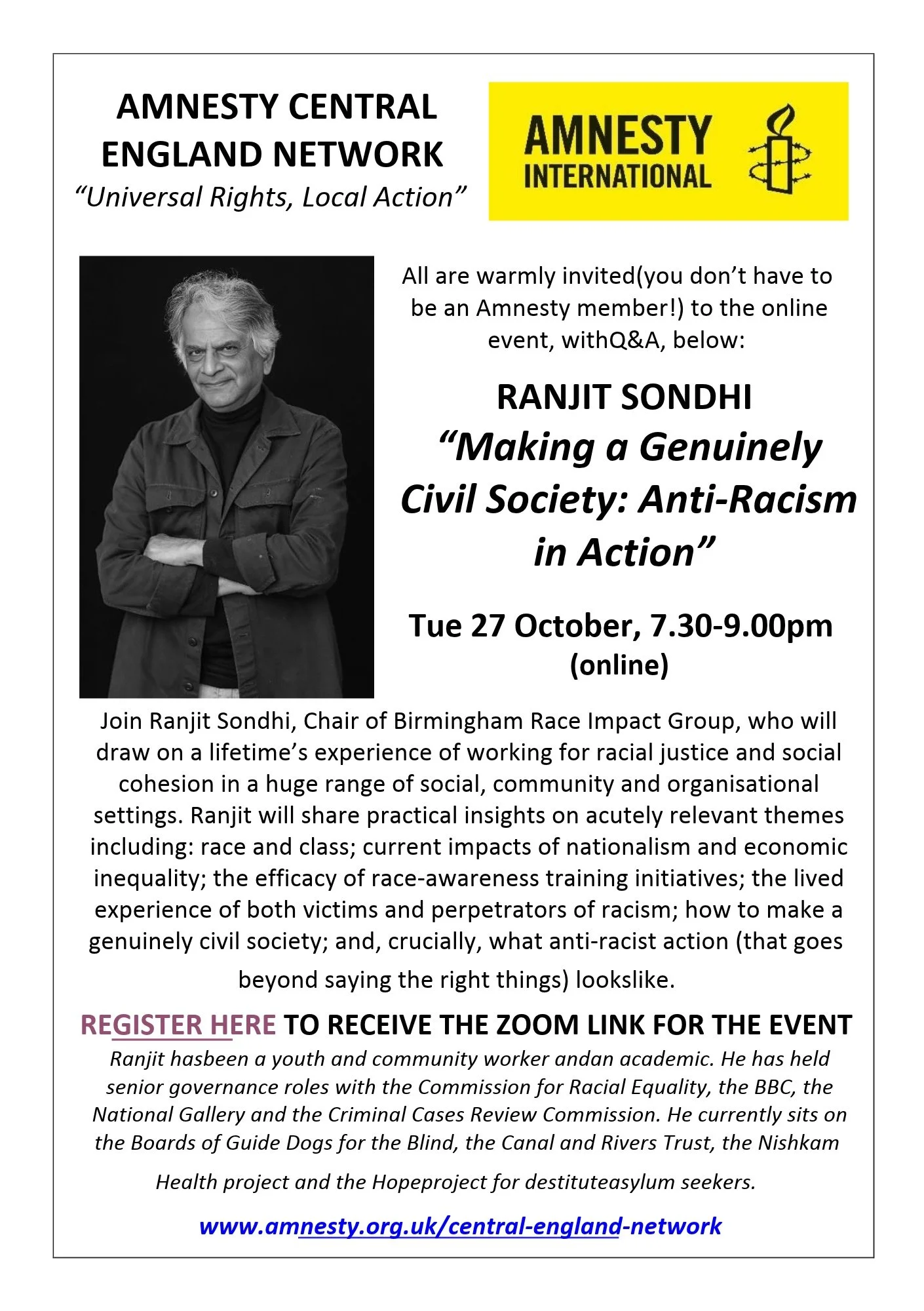
On Tuesday 27 October 2026, Ranjit Sondhi, Chair of Birmingham Race Impact Group (BRIG), delivered an online talk titled “Making a Genuinely Civil Society: Anti-Racism in Action,” hosted by Amnesty International's Central England Network.
Drawing on his extensive experience working for racial justice and social cohesion, Ranjit explored the relationship between race, class and nationalism, the growing impact of economic inequality, and what meaningful anti-racist action looks like in practice.
Ranjit highlighted the wider global and national challenges shaping the fight against racism. Growing economic inequality, the weakening of international human rights protections, the rise of populist nationalism and increasing political division have created conditions in which racism can thrive. He also pointed to the retreat from equality, diversity and inclusion initiatives and the growing influence of anti-immigration narratives. Against this backdrop, tackling racism requires more than addressing individual prejudice; it means challenging the wider social, political and economic inequalities that continue to divide communities.
About Birmingham Race Impact Group
Birmingham Race Impact Group (BRIG) is a multigenerational, region-wide movement dedicated to tackling racial inequalities, with the ambition of making Birmingham an anti-racist city by 2035. Bringing together community activists, academics, civic leaders, organisations and people with lived experience of racism, BRIG works to challenge discrimination, hold institutions accountable and create opportunities for meaningful change. Its mission is to build on the achievements of previous generations while empowering young people to shape a fairer, more inclusive and anti-racist Birmingham and West Midlands.
Turning Anti-Racism into Action
Moving from discussion to practical solutions, Ranjit outlined BRIG's seven-level approach to anti-racist action, which focuses on:
Public commitment – Encouraging organisations to openly commit to tackling racism.
Evidence and lived experience – Listening to communities and understanding the inequalities they face.
Shared priorities – Working together to identify problems and agree on solutions.
Community dialogue – Creating spaces for honest conversations about identity, culture and belonging.
Accountability – Ensuring organisations deliver on their promises.
Long-term change – Making anti-racism an ongoing priority rather than a short-term response.
Collective responsibility – Bringing communities and institutions together to maintain progress.
Through initiatives such as BRIG Café, Seeking the Pioneers and the Beyond Racism Partnership, BRIG is working to turn these commitments into meaningful action.
Building a Society Beyond Racism
Ranjit concluded by encouraging people to rethink how we understand identity and belonging.
He emphasised that cultural and national identities are important, but they should not be used to divide or exclude others. Instead, our differences should be recognised as something that strengthens society.
Building a genuinely civil society means creating communities where everyone is treated with dignity, institutions are accountable, and people have equal opportunities to succeed.
For BRIG, achieving this vision requires continued collaboration, community involvement and a shared commitment to justice and equality.
Tackling racism requires more than words. It requires meaningful action, lasting change and a collective commitment to building a society where everyone belongs.
