
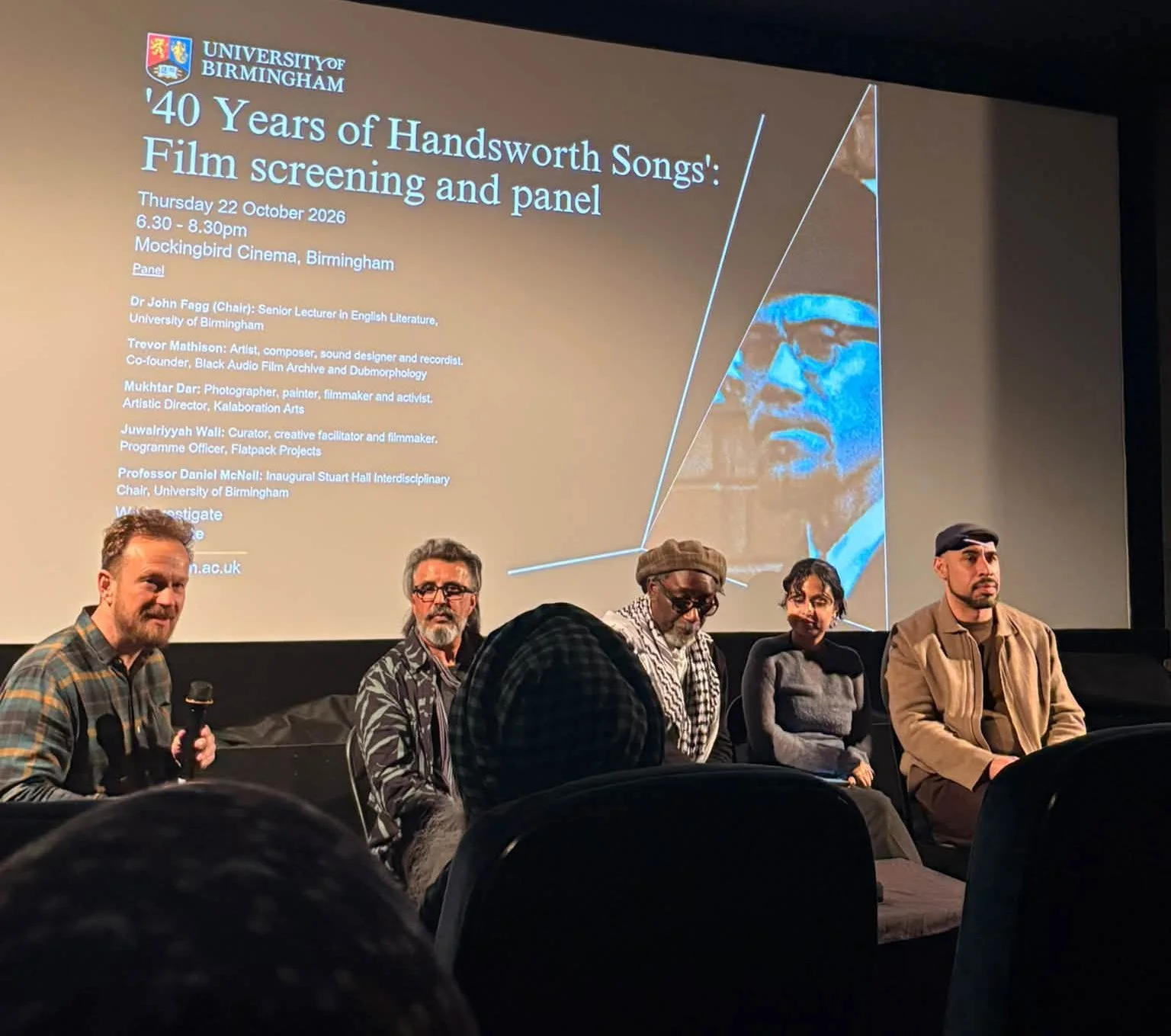
This article develops arguments from Mukhtar Dar’s contribution to a panel discussion marking the 40th anniversary of Handsworth Songs (1986), alongside Trevor McIntosh and Trevor Mathison of the Black Audio Film Collective. The event took place on Thursday 22 October 2026, with a screening and Q&A at Birmingham School of Art, followed by a screening at Mockingbird Cinema, The Custard Factory, Birmingham. It was delivered through the University of Birmingham’s Culture Forward initiative, in collaboration with Birmingham Museums Trust, Vivid Projects and the ESRC Festival of Social Science.
Forty years after the Handsworth uprising, the ghosts of empire, racism and economic dispossession have returned. No longer hiding in the closets of respectable society, they march through our streets, mobilise online and knock on the doors of political power.
“There are no stories in the riots, only the ghosts of other stories.”
Few lines in British cinema are as haunting or prophetic as this refrain from Handsworth Songs, John Akomfrah and the Black Audio Film Collective’s landmark film of 1986. It reminds us that a riot is never simply a riot: behind the flames lie histories, behind the anger lie grievances, and behind the spectacle lies a society unwilling to confront itself.
The Handsworth uprising of 1985 emerged from deindustrialisation, unemployment, attacks on organised labour and the punitive policing of Black communities. Factories closed, jobs disappeared and young people were denied a future. Yet when they rebelled, the cameras captured the flames, not the fuel.
The film refuses this easy story. It asks whose history is remembered, whose suffering is explained away and whose anger is declared a threat. Forty years later, the question is not whether those ghosts have returned, but why we have allowed them to make themselves at home.
The Making of a Racial Scapegoat
An economic system driven by the pursuit of profit produces inequality, but inequality does not automatically create solidarity. When people lose their jobs, homes and security, their anger can turn upwards towards those who hold wealth and power, or sideways towards neighbours portrayed as responsible for their misfortune.
Racism provides that diversion. It gives economic pain a racial face and offers the false comfort of an enemy. Migrants are blamed for housing shortages, refugees for failing public services and Muslims for the supposed loss of national identity, while the forces shaping wages, rents, investment and public spending escape scrutiny.
The trick is as old as empire: divide those who share material interests by persuading them they do not share a common fate. Asian and African Caribbean communities know this double burden; their labour is welcomed when profitable, but their belonging is questioned when politically convenient.
Britain has never fully reconciled the wealth accumulated through colonial domination with the racial hierarchies that helped produce it. Today, deindustrialisation, insecure employment, unaffordable housing, deteriorating public services and weakened working-class institutions have created fertile ground for resentment.
These conditions do not inevitably produce racism. The crucial question is who explains people's circumstances, where their anger is directed and whether they are offered a collective means of changing their lives. When credible alternatives are absent, the far right offers a counterfeit solution: national belonging instead of economic security, racial hierarchy instead of equality, and an enemy instead of an explanation.
The Mainstream Opened the Door
The far right did not create the grievances it exploits. Successive Conservative and Labour governments have pursued different policies, but both have operated within an economic order that has too often placed market priorities above working people's needs.
The door has also been opened by mainstream political rhetoric. For years, immigration has been presented as a problem to control, migrants as a burden to manage and national identity as something threatened by outsiders. When established parties adopt the language of their far-right challengers, they risk legitimising the very assumptions they claim to oppose.
Once the debate becomes how harshly migrants should be treated, rather than why housing is unaffordable or public services are failing, the political terrain has already shifted. The far right does not need to win every argument if its opponents have already accepted the terms of the debate.
Reform UK has channelled disillusionment with government and frustration over living standards into a programme centred on immigration restriction, national sovereignty and opposition to the political establishment. Its appeal cannot be explained by prejudice alone, but its political response directs grievances towards migrants and outsiders rather than confronting the deeper structures shaping insecurity and inequality.
Workers are encouraged to compete for jobs, housing and public resources while the ownership and distribution of wealth receive far less attention. The contradiction is clear: a politics claiming to speak for working people can direct their anger towards other working people whose vulnerability is even greater. The powerful remain powerful; the powerless are encouraged to fight among themselves.
When the Flag Becomes a Weapon
The far right’s growth is visible not only at the ballot box but also on the streets. Unite the Kingdom, Patriotic Platform, Britain First and Raise the Colours represent different strands of civic nationalism, ethno-nationalism and anti-migrant mobilisation. In different ways, they contribute to a political climate in which migrants, refugees and racialised communities are increasingly portrayed as outsiders and their right to belong is called into question.
These movements can normalise hostility, embolden intimidation and create an atmosphere in which people's safety and belonging feel conditional. Their demonstrations also provide a spectacle of collective power, amplified through digital networks and carried into everyday conversations.
I have never put my faith in flags. They can blind working people to the realities that unite them, persuading them to identify with a national symbol rather than recognise their shared position in society. A flag can conceal the divide between those who own and those who labour, between those who make decisions and those who bear the consequences.
The problem is not that people value their histories or communities. It is that nationalism can turn attachment into a hierarchy of belonging, declaring some the rightful owners of a country and others permanent guests. A flag cannot feed a family, build a house or restore a public service, but it can persuade a hungry person that their neighbour is the reason they are hungry.
We must look beyond the spectacle to the material conditions beneath it. Who benefits when working people are divided by race, and what becomes possible when those who share the same struggles recognise one another as allies rather than enemies? The answer is not another flag or a mythical national past, but solidarity grounded in people's lived realities.
When Resistance Becomes Heritage
The 40th anniversary of Handsworth Songs matters because the film is more than a landmark of Black British art. It is an argument about power: who tells the story, whose suffering counts as history and how the past continues to shape the present. Yet there is a contradiction in celebrating resistance while neglecting the conditions that made it necessary.
The Black arts and community arts movements of the 1970s and 1980s did more than demand representation. They created independent spaces, developed new forms of expression and connected cultural work to the struggles of their communities. Culture was not an ornament to politics; it helped people name their oppression, recover their histories and imagine alternatives.
What weakened this tradition was not simply funding cuts, but co-option: the absorption of radical cultural energies into institutional frameworks that could recognise difference without challenging inequality. The language of resistance became the language of diversity, while demands for structural change were increasingly translated into programmes of representation.
This was not a simple story of betrayal. Institutions can preserve important work and bring neglected histories to new audiences, but recognition can also neutralise a movement's political challenge. A radical idea can survive in a museum long after its capacity to disturb the present has been removed.
The question is not whether we should commemorate Handsworth Songs, but whether commemoration inspires new cultural and political work or substitutes for it. If we preserve the memory of resistance while allowing the independent spaces, relationships and political purpose that sustained it to disappear, we keep the archive and lose the living tradition.
From Commemoration to Collective Action
The far right understands that politics is not won by arguments alone. It shapes what people feel, what they fear, what they believe is possible and whom they consider their own. Its culture lives in street demonstrations, online influencers, viral videos and stories of a country supposedly stolen from its rightful owners.
We cannot defeat this politics simply by telling people they are wrong. We must confront racism without abandoning those vulnerable to its appeal, listen to discontent without endorsing its scapegoats, and offer belonging without exclusion. That means connecting anti-racism to struggles over wages, housing, public services, education and the distribution of wealth and power.
We must rebuild independent cultural spaces and lasting relationships between artists, trade unions, grassroots organisations, community groups and anti-racist movements. Film, music, theatre and community arts must do more than represent people's experiences: they must help turn private frustrations into shared understanding and collective action.
We need a political culture that supports and contributes to a political movement: one that takes anti-racist ideas into workplaces, streets, schools and community spaces; challenges the far right wherever it organises; develops political understanding; and builds collective power to transform the conditions that sustain racism.
Artists must do more than depict the world, and cultural institutions must do more than commemorate those who challenged it. Our festivals, exhibitions and screenings must contribute to the wider struggle, building relationships and sustaining the organisations through which resistance becomes a living, collective force.
If our cultural work does not strengthen the movement, if our festivals do not build solidarity and our commemorations do not contribute to political action, we risk turning a history of resistance into a sanitised jamboree: celebrating yesterday's rebels while leaving today's reactionaries to shape tomorrow.
The ghosts are speaking. We know their history, and we can see the consequences of leaving their stories unchallenged. Now we must organise: rebuild a political culture rooted in solidarity, confront racism in the streets and structures of power, and create a movement capable of transforming the conditions that allow the past to return.
The point is not simply to remember the rebellion of 1985. It is to carry its unfinished struggle into the present — and build the collective power needed to change the future.