
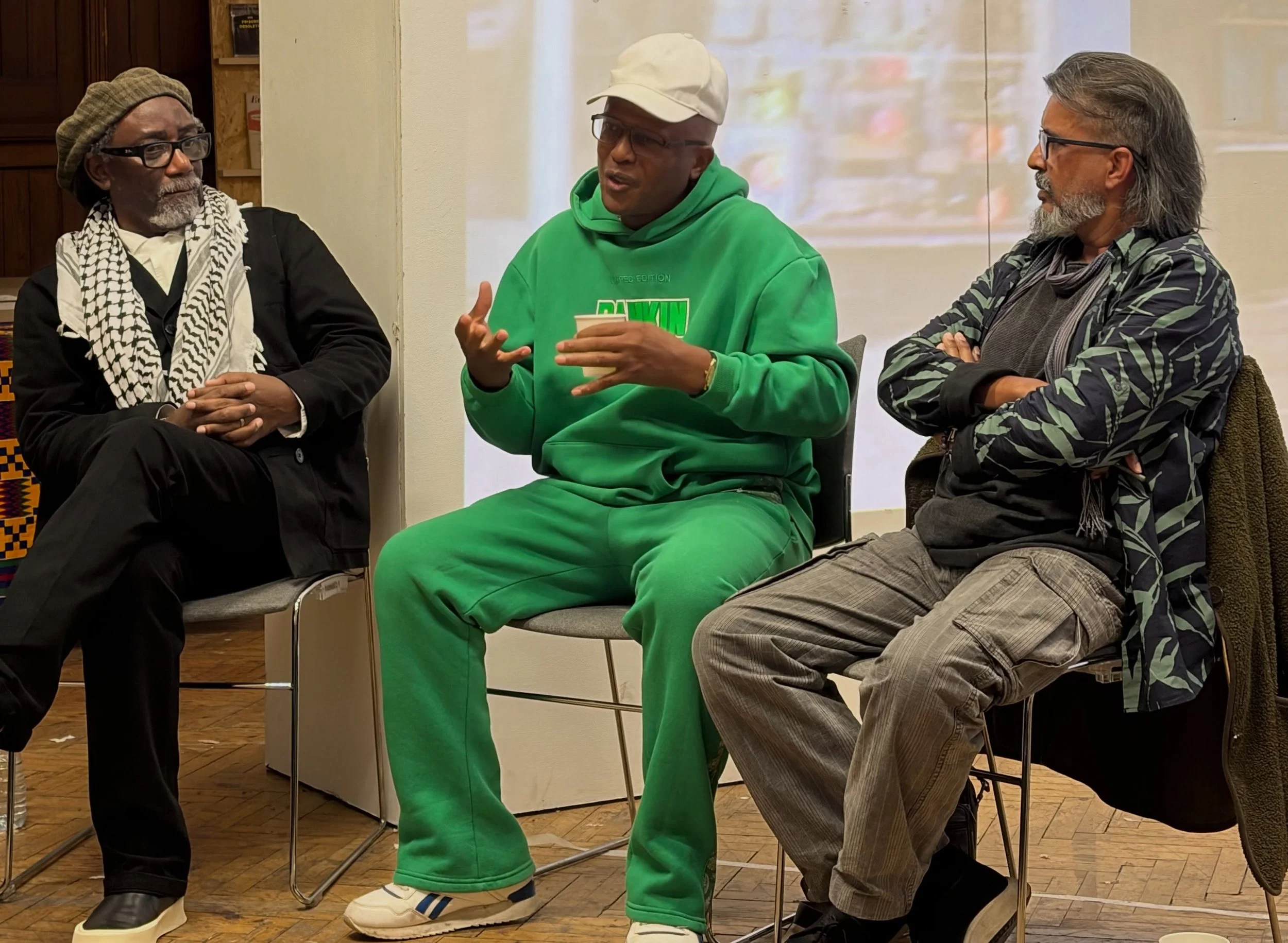
On Saturday 17 October 2026, I joined Lamin Touray, Karen Lockney and Sashwati Sengupta at the Together Alliance Northern Summit at King’s House, Manchester. Our workshop, “How Do We Build a Counter-Culture Against the Far Right?”, posed a question that goes beyond the immediate task of opposing racist demonstrations. How do we create a culture in which the far right struggles to take root, where solidarity is lived rather than proclaimed, and where the anger of ordinary people becomes a force for social transformation rather than a weapon against one another?
The far right has understood something that too often escapes its opponents: politics is not only a battle for votes, policies or the streets. It is a battle for hearts and minds, for memory and imagination, for the meaning of belonging. Its flags, music, slogans and spectacles offer people a story about who they are, what they have lost and whom they should blame. Beneath the performance of patriotism lies a politics of exclusion, turning insecurity into resentment and neighbours into enemies.
But why does that story find an audience? Why, in a society capable of producing extraordinary wealth, are so many people struggling to afford a home, secure decent work or access the public services they need? The far right feeds on these contradictions while directing anger away from the distribution of wealth and power towards migrants, refugees, Muslims and racialised communities. It offers the comfort of an enemy instead of an explanation of the system that produces insecurity.
Our task is not simply to oppose the far right’s culture of hatred. It is to create a culture of resistance that gives people a different way of understanding their lives, their common interests and their capacity to change society.
When Culture Became Resistance
We have been here before. In the 1970s, as the National Front advanced and racist violence scarred working-class communities, Rock Against Racism brought punk and reggae, Black and white young people, musicians and activists into a common struggle. Working alongside the Anti-Nazi League, it transformed music into a meeting place for resistance. People came for the music and discovered that they were not alone.
Its importance lay not simply in the concerts, but in the connections between cultural expression and political organisation. Music gave resistance a rhythm; the movement gave it direction. Culture made anti-racism visible, emotional and participatory. It offered a counter-narrative to a society in which racism was being normalised and made collective action imaginable.
Yet we cannot simply summon the ghosts of that movement and expect them to do our work for us. The world has changed. The far right now mobilises through digital platforms as well as streets and public squares, manufacturing outrage, circulating conspiracy and building virtual communities around grievance. We have new tools, but the fundamental question remains: who is shaping the stories through which people understand the world?
The history of the Black arts and community arts movements carries a further warning. Independent cultural spaces once gave communities the means to tell their own stories, challenge racism and connect creativity to political struggle. Much of that infrastructure has weakened. Some radical energies have been absorbed into institutional frameworks where diversity and representation can be celebrated while the structures producing inequality remain largely untouched.
Representation matters, but it is not the same as power. Inclusion is not transformation. Culture becomes harmless when it is separated from the communities and struggles that gave it meaning. The challenge is not to retreat from institutions, but to preserve an independent voice and a living connection between cultural work and collective resistance.
From Grief to Resistance
I learned the meaning of this connection through struggle. When I lived here in Manchester in 1992, Siddik Dada and Mohammed Sarwar were brutally murdered in racist attacks. While the police initially treated the attacks as robberies gone wrong, we believed they were racist murders. Alongside the families, through the Black People’s Alliance and the Siddik Dada and Mohammed Sarwar Memorial Committee, we organised a campaign for justice supported by the families.
We knew that condemnation alone would not be enough. We choreographed demonstrations, produced a campaign video, commissioned poetry and distributed black flags to taxi drivers. When Mohammed Sarwar’s body was released to be flown home to Pakistan, we called on taxi bases to close and shops along the curry corridors to shut as the funeral procession passed. Thousands of taxi drivers joined the procession, which Manchester Metro News reported as the largest in the city’s history.
We transformed private grief into public resistance. Culture was not an embellishment to the campaign; it was part of how we organised, mobilised and made our collective presence felt. The procession carried sorrow, but it also carried a demand: our lives matter, our communities will not be abandoned, and racism will not pass unchallenged.
Years later, after moving to Kings Heath, Birmingham, I witnessed how quickly racism could shatter a community’s sense of security. In 2023, during Ramadan, a 73-year-old Muslim man, Mr Naseem, was brutally attacked while walking home from the mosque. Working alongside his family and local residents, we organised a Unity Weekender, bringing together musicians, artists, poets, local businesses and people from different backgrounds. It was our way of saying that Islamophobia would not define our neighbourhood, nor would we allow fear to divide us.
But we wanted unity to outlive the weekend. The relationships forged through that initiative helped establish Kings Heath United Against Racism (KHUAR). Alongside this, we developed Kalab Lounge, a new model of independent cultural organising: a free monthly live-music night where we programmed the artists, the venue landlord paid the bands, and local people came together through music.
It was more than entertainment. It created a regular anti-racist space for people to meet, build friendships and discover common ground. Kalab Lounge turned neighbours into comrades, showing how an independent cultural space, rooted in its neighbourhood, could nurture the relationships from which solidarity and collective action grow.
This is what the late anti-racist thinker A. Sivanandan meant by “communities of resistance”: not simply communities that experience racism together, but communities that organise collectively to challenge it. Shared suffering does not automatically produce solidarity; solidarity must be built, practised and sustained. It grows through the everyday encounters that turn strangers into neighbours, neighbours into comrades, and a shared sense of belonging into the collective strength to confront injustice.
Beyond the March, Beyond the Festival
In Birmingham, our work through Unite the People, developed as the cultural wing of Stand Up to Racism, seeks to carry this principle into a city-wide movement. The Unity March and Rally brought together more than 2,000 people through a programme of music, performance, speakers and drumming, alongside trade unionists, community activists, families and young people.
For a moment, people from different generations and backgrounds occupied the same public space, not as strangers competing for recognition, but as people asserting a shared refusal to be divided. That matters. A culture of fear is challenged not only by argument, but by the experience of collective courage.
Yet we must resist the temptation to mistake the event for the movement. A concert cannot resolve the housing crisis. A festival cannot redistribute wealth. A rally cannot, on its own, dismantle the institutions and inequalities that reproduce racism. Cultural activity becomes politically meaningful when it helps people move from participation to organisation, from a shared moment to a sustained struggle.
The question after every event must be: what happens next? Do people become involved in their neighbourhoods, workplaces and trade unions? Do young people gain the resources to create their own art, music, film and digital media? Do new relationships strengthen campaigns and organisations? Does the energy generated in a public square find a home in a wider movement?
Culture can open the door, but organisation must take us through it.
We need to tell a different story from the far right’s narrative of decline and invasion: a story of working-class solidarity, migration, mutual aid and resistance. We need spaces where solidarity can be experienced — in music venues, schools, community centres, galleries, workplaces, festivals and online. We need to give young people the means to become creators rather than passive consumers. Above all, we must connect cultural expression to political education and organised action.
This requires a broad united front. We will not agree on everything, nor do we need to. We come from different traditions, communities and political experiences. But we can unite around a common determination to challenge racism and fascism. Artists can work alongside trade unionists; students alongside community activists; faith groups alongside cultural organisations; migrants alongside those whose families have lived here for generations. Our differences need not divide us when we recognise the common interests that bring us together.
Building the World We Want
The far right tells ordinary people that there is not enough for everyone and that survival depends on keeping others out. Our answer must be to challenge the conditions that make insecurity a daily reality, rather than allowing frustration to be redirected towards those who are also struggling. We must connect the fight against racism to the fight for decent housing, secure work, public services and a society in which wealth and resources serve human need.
This is where culture and politics must meet. Culture without organisation risks becoming spectacle; politics without culture risks becoming abstract, disconnected from people’s emotions, memories and everyday lives. We need both: the imagination to make another world possible and the collective power to bring it into being.
The far right offers identity without equality, belonging through exclusion and pride at the expense of others. We must offer belonging without an enemy, pride without superiority and solidarity without borders of race or religion. We must make anti-racism not simply a position people declare, but a culture they help create and a practice they carry into everyday life.
The task is not to produce a sanitised cultural jamboree that briefly celebrates diversity while leaving injustice untouched. It is to build an independent, creative and organised counter-culture that strengthens the anti-racist movement and challenges the economic and political conditions on which the far right feeds. Rock Against Racism showed what was possible. Our experiences in Manchester and Birmingham show that the work continues — in our streets, our neighbourhoods, our cultural spaces and our collective struggles.
If the far right builds a culture of fear, we must build a culture of courage. If it builds a culture of hatred, we must build a culture of solidarity. If it builds a culture of division, we must build a culture of unity.
The ghosts of earlier struggles are not here to rescue us. They are here to remind us that people before us created movements from the resources they had, in the circumstances they faced. Our responsibility is to do the same in our time: to turn culture into connection, connection into solidarity, and solidarity into organised resistance.
The struggle is not simply to defend the world we have. It is to create the world we want.
Let us build the culture, build the solidarity and organise the resistance.