
Bonnie Greer was a writer, critic and broadcaster who crossed continents, challenged conventions and inspired generations. Born in Chicago, she made Britain her home in the second half of her life, becoming an influential voice on race, culture, identity and belonging.
Three women: Anita Bhalla, Deirdre LaBassiere, and Nina Robinson pay tribute to Bonnie Greer in this special BRIG Newsletter reflections piece on her life and legacy.
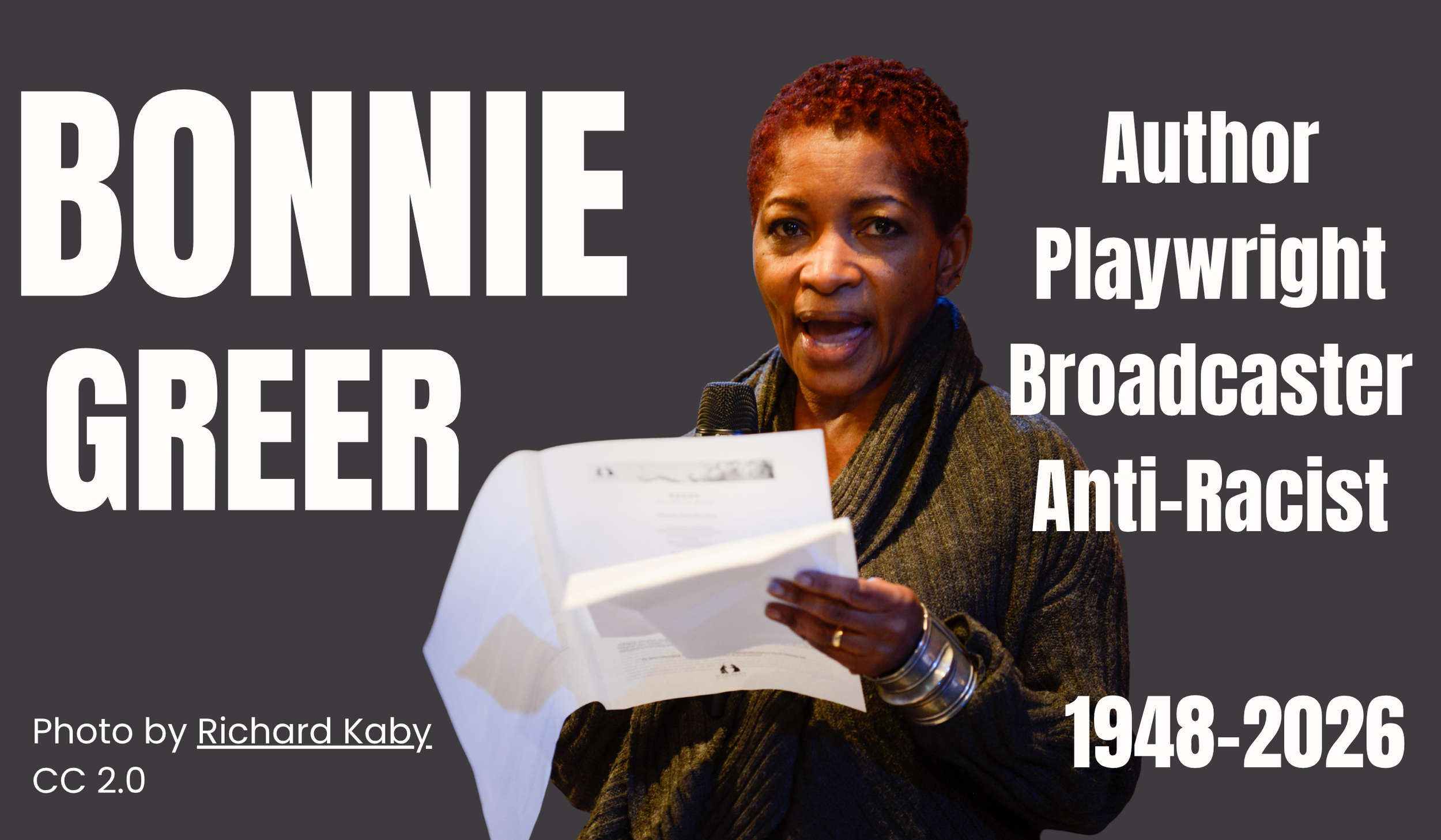
A Tribute to Bonnie Greer: Writer, critic, broadcaster and cultural force
by Anita Bhalla
“She occupied spaces that had not always made room for voices like hers.”
Bonnie Greer leaves behind a vast and generous legacy: as a playwright, novelist, critic and broadcaster, she brought intellectual courage, warmth and clarity to the public life of Britain and beyond. Born in Chicago and later making Britain her home, she carried with her a deep understanding of history, migration, race, theatre and belonging — and she shared that understanding with precision, humour and grace.
Her voice was distinctive not simply because it was recognisable, but because it enlarged the conversation. Whether writing for the stage, reflecting on literature, serving cultural institutions or appearing on television, she asked audiences to think more deeply and listen more carefully. She had the rare gift of combining scholarship with accessibility: she could illuminate a difficult truth without diminishing its complexity.
Greer’s work often centred lives and stories that had too often been pushed to the margins. She explored the experiences of women, Black communities, artists and outsiders with a seriousness that was never cold, and with a compassion that never softened her critical edge. In doing so, she helped widen the cultural record and reminded us that art is one of the ways a society learns to tell the truth about itself.
She will also be remembered for her presence in public debate: calm, exacting, witty and unafraid. At a time when public conversation could become narrow or performative, Bonnie Greer brought context. She met noise with knowledge, prejudice with steadiness, and simplification with a life’s worth of reading, writing and experience.
For many women of colour, Greer was more than a commentator or cultural figure; she was a visible example of intellectual authority worn with ease. She occupied spaces that had not always made room for voices like hers, and did so without apology. In her confidence, range and refusal to be diminished, many saw a model of what it meant to think publicly, speak clearly and belong fully.
To pay tribute to Bonnie Greer is to honour not only what she made, but how she moved through the world: with curiosity, independence, discipline and imagination. She showed that criticism could be an act of care, that culture could be a place of argument and welcome, and that a writer’s task is not merely to speak, but to make space for others to be heard.
Bonnie Greer OBE: A Fearless and Unapologetic Voice
by Deirdre LaBassiere
“Her journey resonates with me personally as a Black woman of Caribbean heritage who has also sought to bring her full identity into British public and institutional life.”
The passing of Bonnie Greer OBE is a profound loss to British cultural and public life.
Bonnie was an extraordinary writer, playwright, critic and broadcaster, but she was also a fearless Black woman who understood the power of occupying spaces in which voices like hers had too often been absent and of speaking with intelligence, clarity and courage once she was there.
Born in Chicago and making Britain her home, Bonnie brought a perspective that crossed cultures and continents. Her journey resonates with me personally. As a Black woman of Caribbean heritage who has also sought to bring her full identity into British public and institutional life, I understand something of what it means to enter rooms that were not designed with us in mind, not simply to occupy a seat, but to use that position to question, influence and open doors for others.
Whether confronting racism in public debate, writing about identity and the experiences of women, or contributing to the governance of major cultural institutions, Bonnie refused to make herself smaller or her message more comfortable for others. Her memorable appearance on Question Time alongside BNP leader Nick Griffin demonstrated that challenging racism does not always require shouting the loudest; sometimes its greatest power lies in being informed, dignified and utterly unshaken.
Bonnie expanded our national conversation and made it easier for others to follow.
May she rest in peace and power. Her voice, example and legacy will endure.
Bonnie Greer Reflections
by Nina Robinson
“I had to unleash myself as myself, away from the world’s perception of me.”
Bonnie Greer was once asked which of her identities mattered the most to her. Some options were offered by the interviewer, which included Bonnie as a Catholic, feminist, or American-British citizen. She answered;
“I am a Black writer. Because I’m a child of the 60s and early 70s and my dad came from segregation, so I identify as a Black American and write about that experience in the world.”
Bonnie Greer’s father was a factory worker from the South Side of Chicago, a place she was born and raised as the eldest of seven children. She recounted memories of her father, who settled there to work in its factories, as many other African Americans did who travelled from the Deep South to flee the oppressions of slavery via the Railroad.
As part of the generation that followed, Bonnie Greer found that Chicago was still a place of segregation where white flight was under way whilst the white people who remained were as resentful as they were racist. She remembers being taught how to run home through the snow, so that they might avoid the rocks thrown at them by racist gangs.
Her decision to come to the UK was perhaps influenced by her father’s visit to London when he was in the US Army. On arrival, he was amazed to see Black men and women treated with some civility, walking on the street without harassment – something he had never witnessed before.
Bonnie’s father was deeply impacted by his visit to the UK, so much so that the act of naming his children was a nod to the British Royal Family; Bonnie was born two days after King Charles and took the nickname given to him - Bonnie Prince Charlie; Bonnie’s sister was named Regina. Bonnie Greer’s attitude to the Royals – which could be said to extend to other British institutions - transmuted a sense of deference and respect, which she herself understood came from an American perspective which wanted to see the “fairytale.” This view was somewhat punctured by the Oprah interview with Meghan Markle in 2021. In it, Meghan stated that when she was pregnant with her son Archie, the Royals had voiced “concerns and conversations about how dark his skin might be when he was born”.
Bonnie Greer provided her opinion of these revelations in her standing as a cultural commentator for Channel 4 News, where she had to admit that “the [Royal] brand which had launched a thousand ships, had been tarnished.”
As a former staff journalist at the BBC and having worked much of that time for Radio 4, Bonnie Greer was frequently called upon to inject cultural nuance into countless panels and programmes. A quick search on BBC Sounds or iPlayer throws up her contributions to history programmes such as Jamaica’s Morant Bay Rebellion and to Woman’s Hour, where, for example, she spoke of her autobiography, ‘A Parallel Life.’ She said that it offered a portrayal of Black girls which departed from the media’s usual extractive, negative and sexualised contexts, to instead allow for a story which normalised a girl retold in authenticity, growing up in joy, music, clothes and books.
“I had to unleash myself as myself, away from the world’s perception of me.”
In political discourse, Bonnie Greer appeared on Any Questions and Question Time, making 15 appearances on QT, between 2001 and 2025. She addressed the BNP’s Nick Griffin, where she was a formidable and courageous voice to counter far-right racist dog-whistling.
Listening back to many of her contributions, I echo the words of Marcus Ryder, who admires the courage of a Black woman to articulate a solid defence of an anti-racist position, often acting as the bridge that laid a channel of understanding across divides. Marcus writes:
“Being antiracist requires courage. Not simply the courage to say the right things when surrounded by people who agree with you, but the courage to enter difficult spaces, confront uncomfortable ideas and, sometimes, accept criticism from people on your own side.”
For the British, white media establishment, Bonnie Greer’s separation as a Black-American who often admired and respected those institutions, perhaps provided a safe distance from which to view and consider race and racism at home. It removed direct British complicity in racism whilst allowing the comfort of white elites to remain intact. This may be harder to achieve when the voice is Black and British.
Speaking in 2022, Bonnie Greer said of her father, who was born in a time and place where Emmett Till was lynched and when he himself would have been killed for being outspoken:
“My dad always said to us, don’t ever stop anyone from speaking. Just be better than they are.”
Bonnie Greer lived her life by these words.
RIP Bonnie Greer.